
ADC12 Aluminum Die Castings: Oil Resistance, Surface Treatments, and Leak Prevention
Learn how ADC12 aluminum die castings perform in oil-contact applications, when surface treatments are needed, and how porosity control, precision machining, and leak testing help reduce long-term leakage and corrosion.
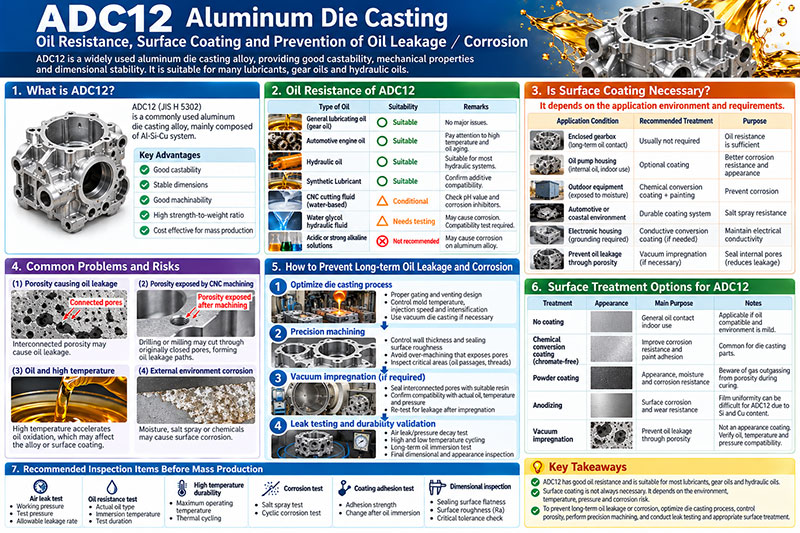
| ox lubricants | Generally suitable | Prioritize leak tightness and sealing surface quality |
| Automotive engine oils | Generally suitable | Validate performance at elevated temperatures and with aged oil |
| Mineral-based hydraulic oils | Generally suitable | Verify pressure resistance and leakage performance |
| Water-miscible cutting fluids | Depends on formulation | Check pH, corrosion inhibitors, and operating concentration |
| Water-glycol hydraulic fluids | Requires validation | Evaluate water content, additives, and material compatibility |
| Acidic or strongly alkaline fluids | Suitability should not be assumed | Conduct material compatibility testing |
These are general guidelines. Final suitability should be verified using the actual fluid and operating conditions.
2. Does ADC12 Require a Surface Treatment?
Not necessarily. The appropriate treatment depends on the application.
| Application or Service Condition | Suggested Approach |
|---|---|
| Interior of an enclosed gearbox exposed to conventional lubricating oil | An uncoated surface may be acceptable |
| Oil pump housing with internal oil exposure and a mild indoor environment | Select treatment according to corrosion and appearance requirements |
| Outdoor machinery exposed to rain and humidity | Consider a conversion coating combined with a suitable protective coating |
| Automotive underbody components or coastal environments | Use a validated corrosion protection system |
| Electronic enclosures requiring electrical conductivity or grounding | Evaluate a conductive conversion coating |
| Castings requiring protection against oil leakage through porosity | Improve casting quality and consider vacuum impregnation where necessary |
ADC12 contains relatively high levels of silicon and a significant amount of copper. These alloying elements can make conventional anodizing more difficult, particularly when a uniform appearance and consistent coating quality are required.
3. How Can Long-Term Oil Leakage Be Prevented?
Leak prevention should be addressed throughout casting, machining, sealing, and final inspection.
3.1 Control Porosity During Die Casting
Optimize the gating system, venting, die temperature, injection speed, and intensification conditions.
Vacuum-assisted die casting may be considered where necessary to reduce entrapped air and the risk of interconnected porosity.
3.2 Maintain Sealing Integrity During CNC Machining
Control oil passage wall thickness, sealing surface flatness, and surface roughness.
Excessive material removal may expose subsurface pores. Particular attention should be given to threaded holes, oil passage intersections, and thin sections near pressurized cavities.
Machining can expose previously enclosed pores and create potential leakage paths. Inspection after machining is therefore essential for components with demanding sealing requirements.
3.3 Use Vacuum Impregnation Where Appropriate
Vacuum impregnation uses a suitable sealant to fill interconnected pores within the casting.
The sealant must be compatible with the actual oil, operating temperature, and pressure. Castings should be leak tested again after impregnation.
Vacuum impregnation can address certain porosity-related leaks, but it cannot be assumed to repair every defect or replace sound casting quality.
3.4 Verify Finished-Part Performance
Establish leak test conditions based on the application’s operating pressure and allowable leakage rate.
Depending on the product requirements, validation may include:
-
Pressure and leak testing
-
High- and low-temperature cycling
-
Extended exposure to the actual oil
-
Seal performance and durability testing
4. Comparing Surface Treatment Options for ADC12
| Treatment | Main Purpose | Important Considerations |
|---|---|---|
| No surface treatment | Applications with compatible oil and mild external conditions | Confirm oil compatibility and corrosion exposure |
| Chromium-free conversion coating | Corrosion protection and pretreatment before painting | Verify performance against the specified corrosion requirements |
| Powder coating | Appearance and protection against moisture and corrosion | Casting porosity may cause outgassing and pinholes during curing |
| Anodizing | Corrosion protection or improved surface wear resistance | Coating uniformity and appearance can be difficult to control on ADC12 |
| Vacuum impregnation | Sealing interconnected pores to reduce leakage | Does not replace an external corrosion protection coating |
Because ADC12 contains silicon, copper, and other alloying elements, anodizing results should be evaluated using representative samples.
For surfaces exposed to oil, verify the coating’s resistance to prolonged immersion, adhesion after exposure, and compatibility with the actual fluid.
5. How Can Long-Term Corrosion Be Reduced?
Corrosion prevention requires attention to both the internal fluid and the external environment.
-
Control water contamination: Monitor moisture in the oil and prevent water ingress.
-
Maintain oil condition: Follow the oil supplier’s maintenance guidance and address oxidation, contamination, or additive depletion.
-
Validate fluid compatibility: Pay particular attention to water-containing fluids and specialty additives.
-
Protect external surfaces: Select a suitable corrosion protection system for humidity, salt exposure, or chemical contact.
-
Inspect coating coverage: Check edges, recesses, and other areas where coating defects may occur.
-
Maintain sealing components: Verify that seals and gaskets remain compatible with the oil and operating temperature.
6. Recommended Validation Before Mass Production
The following items are recommended verification areas, rather than universal acceptance limits for ADC12.
| Inspection or Test | Parameters to Define |
|---|---|
| Leak testing | Operating pressure, test pressure, and allowable leakage rate |
| Oil compatibility testing | Actual oil formulation, exposure temperature, and duration |
| Thermal durability testing | Maximum continuous operating temperature and thermal cycling conditions |
| Corrosion testing | Required salt spray or cyclic corrosion test conditions |
| Coating adhesion testing | Initial adhesion and changes after oil exposure |
| CNC dimensional inspection | Sealing surface flatness, roughness, and hole position tolerances |
Practical Recommendations
For ADC12 gearbox housings or lubricating oil enclosures, prioritize casting porosity control, precision machining of sealing surfaces, and leak testing.
Surface treatments should then be selected according to the actual corrosion exposure and functional requirements. Where moisture, salt, or chemicals are present, an appropriate conversion coating and protective coating system may be necessary.